
Introduction
Certified Mail and Registered Mail sound almost identical, and both prove you posted something important. In practice they differ in security, tracking, cost and legal weight. Choosing the wrong one can mean paying too much — or having no proof when you need it most. This guide compares them side by side, with international equivalents from Royal Mail, Canada Post, Australia Post, India Post, Pakistan Post, La Poste, Japan Post, China Post and DHL.
What Is Certified Mail?
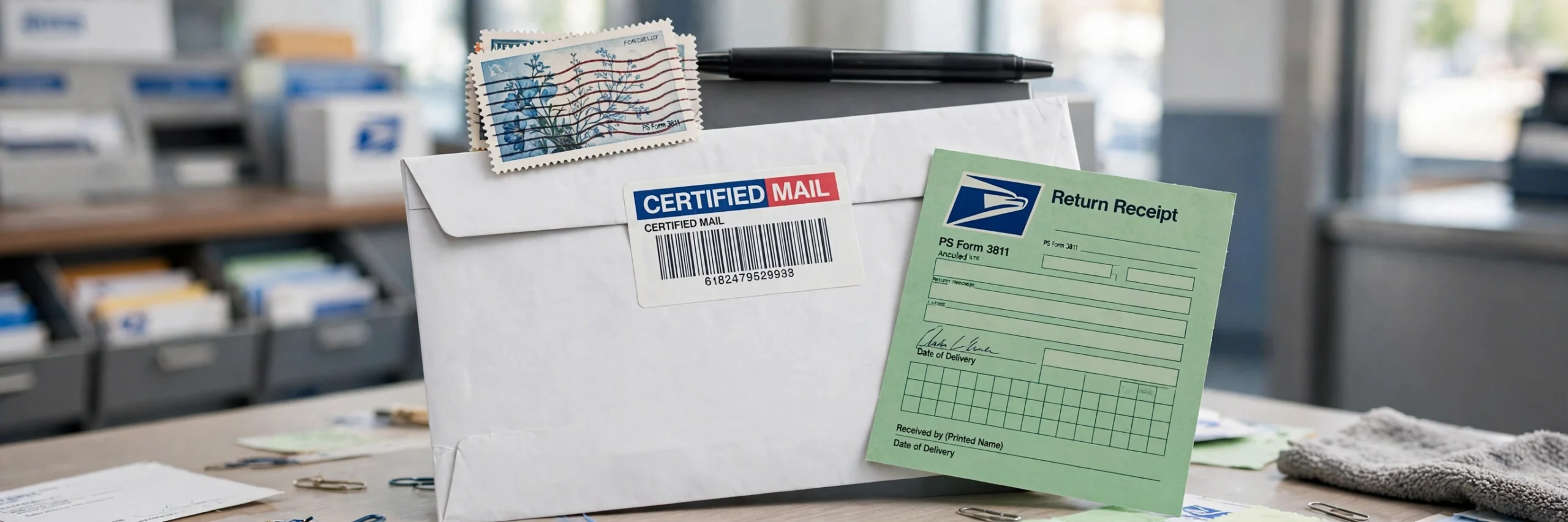
Certified Mail is a US Postal Service (USPS) service. It gives proof of mailing and proof of delivery for letters sent within the United States, and for some international destinations with other services. You get a receipt proving the posting date, a tracking number, and a delivery record. Add Return Receipt and you also get a copy of the recipient’s signature.
It is used for legal notices, tax documents, contracts, court papers and insurance claims where you must prove receipt. It does not include insurance. It is proof of delivery, not high-security transport.
What Is Registered Mail?
Registered Mail is the highest-security service from most national posts, including USPS, Canada Post, Australia Post, India Post, Pakistan Post, La Poste, Japan Post and China Post. It gives a chain of custody — the item is signed for at every handover — plus proof of mailing and delivery, tracking at each stage, compensation up to a declared value if lost or damaged, and delivery only against a signature.
Because of that chain of custody, Registered Mail is slower. It is used for wills, passports, share certificates, jewellery and anything irreplaceable. Internationally it is available to most destinations, but delivery is longer.
Certified vs Registered: Side by Side
| Feature | Certified Mail (USPS) | Registered Mail |
|---|---|---|
| Purpose | Proof of mailing and delivery | Maximum security + proof of delivery |
| Tracking | Yes, end-to-end in the US | Yes, with a signed chain of custody |
| Signature | Optional, with Return Receipt | Yes, always required |
| Insurance | No | Yes, up to the declared value |
| Security | Normal handling | Secure handling, locked storage |
| Speed | Normal First-Class / Priority speed | Slower, due to secure handovers |
| Cost | Low add-on fee | Higher fee, based on value and weight |
| Best for | Legal notices, tax letters, contracts | Wills, passports, valuables, irreplaceable originals |
Certified Mail proves delivery. Registered Mail protects the item.
When to Use Each One
Use Certified Mail when you need to prove delivery — to a court, landlord, employer, tax authority or insurer — when the contents are replaceable, and when you want tracking without paying for high-security handling. It is affordable, widely accepted as evidence, and fast enough for most deadlines.
Use Registered Mail when the item is valuable or irreplaceable — an original passport, a will, a property deed, a share certificate or jewellery — when you want the highest security and compensation, and when the recipient must sign. If losing it would cause serious legal or financial harm, Registered Mail is worth the extra cost and slower delivery.
International Equivalents
UK — Royal Mail: Signed For is closest to Certified Mail. Special Delivery Guaranteed is the high-security, insured domestic service, closest to Registered Mail. Abroad, use International Tracked & Signed.
Canada — Canada Post: Registered Mail, with signature and chain of custody. Xpresspost and Tracked Packet give tracking with a signature option.
Australia — Australia Post: Registered Post gives a signature and tracking.
India — India Post: Registered Post is the secure, signed service. Speed Post (EMS) gives fast tracked delivery.
Pakistan — Pakistan Post: Registered Post and EMS are the main tracked, signed options.
France — La Poste: Lettre Recommandée is the registered letter — tracked, signed, with compensation. Lettre Suivie is closer to Certified Mail.
Japan — Japan Post: Registered Mail (Kakitome) gives a signature and compensation. EMS is fast and fully tracked.
China — China Post: Registered Airmail gives tracking and a signature; EMS is the express service.
DHL: DHL Express gives door-to-door tracking, a signature and insurance, often used instead of Registered Mail for urgent international valuables.
Outside the US, ask for “registered” for maximum security, or “tracked and signed” for proof of delivery at a lower cost.
Cost and How to Send Them
Certified Mail costs a few dollars on top of normal US postage; Return Receipt is extra. Registered Mail costs significantly more, depending on value, weight and destination, and can double or triple the total cost. Do not pay for Registered Mail if you only need proof of delivery.
For Certified Mail, fill in the green-and-white form (PS Form 3800), attach it to the envelope, keep the receipt stub and track it on the USPS site. For Registered Mail, pack securely, take it to the counter — in some countries it must be sealed in front of the clerk — declare the value honestly, and keep the receipt. International Registered Mail also needs a customs form (CN22 or CN23).
Common Mistakes
Certified Mail is not insured — if it is lost, you get proof it was posted, not compensation. Do not use Registered Mail for a routine letter, or Certified Mail for an irreplaceable original. Do not forget Return Receipt when a signature is legally important. And do not assume Certified Mail works the same abroad — it is mainly domestic, so use Registered Mail or a tracked-and-signed service internationally.
Which Should You Choose?
Do you need to prove delivery, or protect the item? If only proof, choose Certified Mail. If protection, choose Registered Mail. Can the item be replaced? If yes, Certified Mail is enough. If no, or if it is valuable, choose Registered Mail.
Frequently Asked Questions
Is Certified Mail the same as Registered Mail?
No. Certified Mail gives proof of mailing and delivery, mainly in the US. Registered Mail gives maximum security, a signed chain of custody, a signature and insurance. It is more secure, slower and more expensive.
Does Certified Mail require a signature?
Not automatically. A signature copy is only provided with Return Receipt. Registered Mail always requires a signature.
Can I send Certified Mail internationally?
It is mainly domestic. For international proof of delivery, use USPS Registered Mail, Priority Mail International, or the sending country’s tracked-and-signed service.
Is Registered Mail insured?
Yes, up to a declared value limit, which varies by country. Declare the value honestly at the counter.