
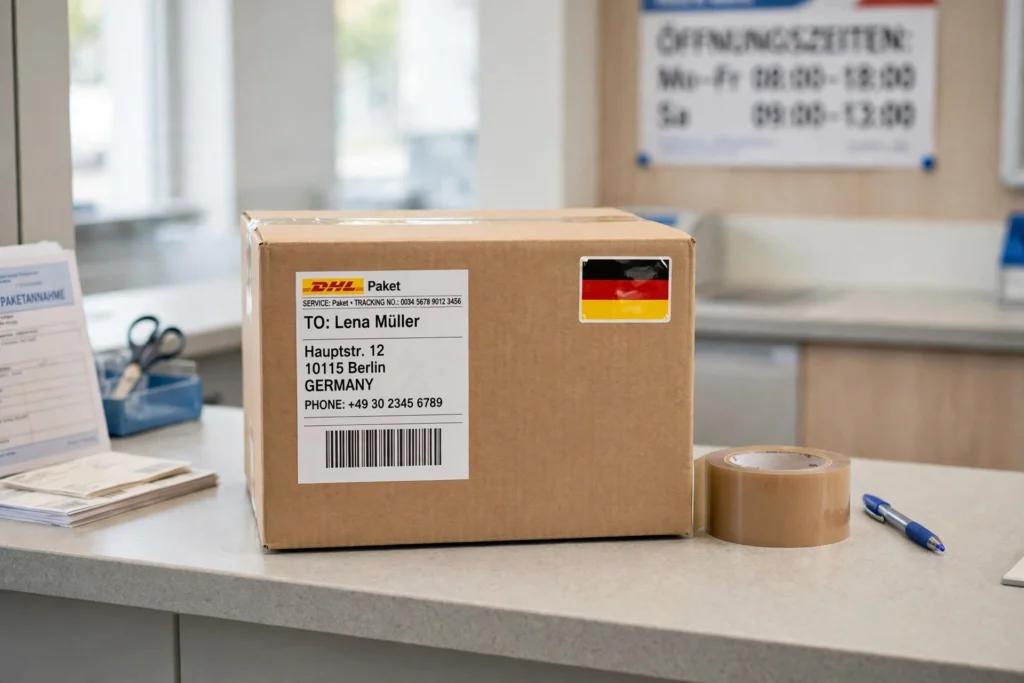
Germany is one of the most popular destinations for international parcels. People send gifts to family, clothes and books to students, products to customers, and documents to offices across the country. How to send a parcel to Germany by post is simple once you know the steps: pack it well, choose a service, fill in the customs form, pay postage, and track it until delivery.
This guide explains how to send a parcel to Germany from the United States, the United Kingdom, Canada, India, Australia and other countries. It covers packaging, customs forms, delivery times, duties and taxes, tracking, and what you cannot send. Prices vary by weight, size and service, so for the exact postage for your parcel, check at your local post office or on the official website.
Step 1: Pack Your Parcel Well
Good packaging is the first step. Germany is in central Europe, and your parcel may travel by air, road and local delivery van before it reaches the address. Use a strong cardboard box that fits the contents with a little extra space for padding. Wrap fragile items individually in bubble wrap or paper, and fill empty gaps so nothing moves inside. Weigh your parcel at home if you can, to help compare services and estimate the cost. Measure the length, width and height too, because some services charge by size as well as weight.
Step 2: Write the German Address Correctly
Write the recipient address clearly on the outside of the parcel. Use capital letters and include the full name, street name and house number, postcode and city, and the country name GERMANY. A German postcode has five digits, for example 10115 for Berlin or 80331 for Munich. Double-check the spelling of the name, the street name, the house number and the postcode. A small mistake can delay delivery by days, or send the parcel to the wrong address. Put a second copy of the address inside the box as well, in case the outer label is damaged.
Step 3: Choose a Postal Service to Germany
Most postal services offer several options for Germany. Economy or standard airmail is the cheapest choice, and it suits gifts and low-value items that are not urgent. Tracked services cost a little more and let you follow the parcel online. Express services are the fastest, with full tracking and delivery in a few working days. From the United States, USPS offers First-Class Package International Service for light parcels, Priority Mail International for faster delivery, and Global Express Guaranteed for urgent items. From the United Kingdom, Royal Mail offers International Standard, International Tracked, and International Tracked and Signed, while Parcelforce Worldwide handles larger and express parcels. From Canada, Canada Post offers Small Packet International, Tracked Packet and Xpresspost International. From India, India Post offers International Air Parcel and EMS Speed Post. From Australia, Australia Post offers International Standard, International Express and International Courier. DHL also delivers to Germany from most countries, and inside Germany parcels are delivered by Deutsche Post and DHL. Ask at your local post office which services are available for Germany, and check the official website for current rates and delivery times.
Step 4: Fill in the Customs Form
Parcels sent to Germany from outside the European Union need a customs declaration. You can usually complete this form online before you visit the post office, or on paper at the counter. The form asks for the sender and recipient names and addresses, a clear description of each item, the quantity, the value of each item, the total value, and the reason for sending. Parcels sent from inside the European Union do not need a customs form. Describe items clearly. Write “cotton T-shirt, size medium” instead of just “clothes”, and “paperback novel” instead of just “book”. Use the real value of each item. Do not understate the value to avoid duty, as this can cause delays, fines or seizure of the parcel. If it is a gift, mark it as a gift and give its real value. German customs (Zoll) uses this form to decide whether duty or import VAT is due. Keep a copy of the form and your posting receipt. Since 2021, import VAT generally applies to goods arriving in Germany from outside the European Union, even on low-value items, and the recipient may have to pay it before the parcel is delivered. The exact rules and thresholds change, so check the Zoll website or check at your local post office for current rules before you send. Medicines need special care. If you are sending medicine to Germany, check the rules first, as some medicines are restricted and may need a prescription or a doctor’s letter. Food, seeds and plants also have special rules, so check the country guide before you pack.
Step 5: Pay Postage and Post Your Parcel
Take your packed parcel and your completed customs form to the post office. Staff will weigh and measure the parcel, confirm the service, and print the postage label and customs form to attach to the parcel. You will receive a receipt with a tracking number if you chose a tracked service. Keep this receipt safe until the parcel is delivered. Postage depends on weight, size, destination and service. For the exact price, check at your local post office or on the official website.
How to Send a Parcel to Germany: Delivery Times, Duties and Tracking
Delivery time depends on where you are sending from and which service you choose. As a general guide, express services from the United States, the United Kingdom and other countries often arrive in 3 to 7 working days. Standard airmail usually takes 7 to 14 working days. Economy or surface mail can take 3 to 8 weeks. Parcels sent from inside Europe are often faster, and delivery to remote or rural areas can take several extra days. Tracking may stop while the parcel is in customs, which is normal. The recipient in Germany may have to pay import duty, import VAT (Einfuhrumsatzsteuer), and a handling fee when the parcel arrives from outside the European Union. This depends on the value of the contents and the type of item. The threshold and the rules change, so check the official website of German customs (Zoll) or check at your local post office for current rules. Check the country guide for Germany on your postal service website before you pack, as some items are prohibited or restricted. If you chose a tracked service, use the tracking number on your receipt to follow the parcel online, on your own postal service website and on the Deutsche Post or DHL website once it arrives in Germany. If the expected delivery date has passed and tracking has not updated, contact your postal service with the tracking number. The sender usually files a missing parcel enquiry, as they hold the receipt.
Frequently Asked Questions
How long does a parcel take to reach Germany by post?
Express services often take 3 to 7 working days, standard airmail 7 to 14 working days, and economy mail 3 to 8 weeks. Parcels from inside Europe are often faster. Delivery to remote areas and customs clearance can add extra days.
Do I need a customs form to send a parcel to Germany?
Yes, if you are sending from outside the European Union. Every parcel from outside the EU needs a customs declaration, even a gift. List each item clearly, give its real value, and state the reason for sending. Parcels sent from inside the EU do not need a customs form.
Will the recipient in Germany have to pay duty or tax?
It depends on the value and type of item, and on where the parcel is sent from. For parcels from outside the European Union, import duty, import VAT and a handling fee may apply. Check the official website of German customs (Zoll) for current thresholds.
Can I send food to Germany by post?
Some foods can be sent, but the rules are strict. Certain foods, seeds and plants are restricted or prohibited, and undeclared food can be seized. Check with your postal service and German customs before sending any food.
Can I track a parcel sent to Germany?
Yes, if you chose a tracked or express service. Use the tracking number on your receipt on your postal service website and on the Deutsche Post or DHL website once the parcel arrives in Germany.