
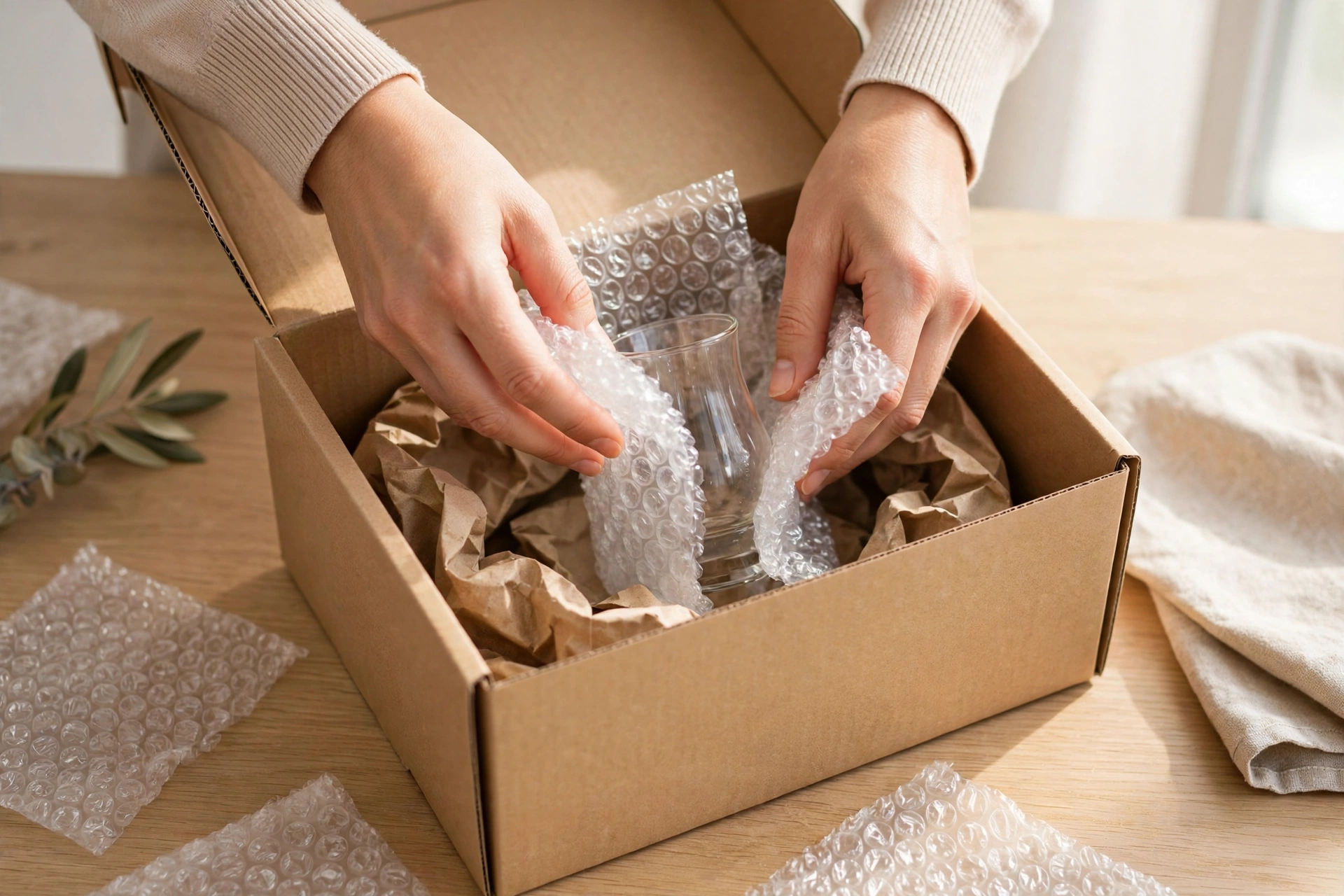
A fragile parcel travels thousands of miles through sorting machines, vans and aircraft before delivery. If it is not packed properly, it can arrive cracked or broken. Good packing is about choosing the right box, cushioning the item on all sides, and labelling it clearly — whether you send by USPS, Royal Mail, Canada Post, Australia Post, India Post, Pakistan Post, DHL, China Post, Japan Post or La Poste.
What Counts as Fragile?
Fragile items are things that can break, crack, bend or be damaged by impact, pressure or vibration: glassware, mirrors, vases and picture frames; ceramics, porcelain and china; bottles of liquid; electronics such as laptops, tablets and cameras; musical instruments; ornaments and collectibles; and clocks and lampshades. If you would worry about dropping it, treat it as fragile — even if it looks strong.
What You Will Need
Gather your materials first: a strong, new corrugated cardboard box (never reuse a weak, damp or crushed box); bubble wrap; packing paper, foam sheets or clean newspaper; packing peanuts, air pillows or crumpled paper; strong packing tape at least 5 cm wide (not sellotape); scissors; a marker pen; “FRAGILE” labels if available; a plastic bag for liquids; and foam corner protectors for frames. Buy the right size box: too big and the item will move around; too small and there will be no room for cushioning.
How to Pack Fragile Items — Step by Step
Step 1: Wrap Each Item Separately
Wrap every item on its own in at least two layers of bubble wrap, bubbles facing inward, and tape the wrap closed. Wrap plates, bowls and glasses individually, with packing paper between them, and never pack unwrapped fragile items touching each other — they will chip or crack. For bottles, wrap the bottle, seal it in a plastic bag in case it leaks, and add extra wrap around the neck, the weakest part.
Step 2: Choose the Box and Line It
Choose a box at least 5 cm larger than the wrapped item on every side, and line the bottom with at least 5 cm of crumpled paper, peanuts or foam. For very fragile or valuable items, use double boxing: pack the item in a smaller box with cushioning, then place that box inside a larger box with at least 5 cm of cushioning on all sides. Double boxing is the best protection for glass, ceramics and electronics sent internationally.
Step 3: Place the Item in the Centre
Put the wrapped item in the centre, away from the walls, top and bottom, and fill all empty spaces so it cannot move when you shake the box. Separate multiple items with cardboard or thick foam. Heavier items go at the bottom, lighter items on top. Pack plates vertically, on their edges like records — they are much stronger that way than stacked flat — and pack glasses upright with paper inside each one.
Step 4: Fill, Shake-Test, Seal and Label
Fill the top with cushioning until level, close the flaps and shake-test: hold the box with both hands and shake gently. If you feel movement, add more filler. Seal with strong tape using the H method: tape along the centre seam, then across both ends, forming an H, and do the same on the bottom. Never use string outside — it catches in sorting machines. Write the delivery address clearly on top and a return address on the back, mark “FRAGILE” on at least two sides, and add “THIS WAY UP” if needed. Stick the postage label and, for international parcels, the customs form on a flat surface. A “FRAGILE” label helps, but it does not guarantee gentle handling — good cushioning is what protects your parcel.
Packing Specific Items
Glass and ceramics: wrap each piece in bubble wrap and paper, pack plates vertically, fill glasses with paper before wrapping, and double-box valuable china. Electronics: remove batteries where possible and pack them separately under the postal service’s battery rules; wrap the device in bubble wrap and foam, use the original box if you have it, and protect the screen with foam or cardboard. Frames and mirrors: tape a large X across the glass with masking tape, wrap in bubble wrap, protect the corners with foam, and use a flat box with cushioning on both sides. Bottles: seal the cap with tape, wrap and bag the bottle, stand bottles upright with dividers, and mark “THIS WAY UP” — but check first, as many perfumes are restricted in international airmail. Musical instruments: loosen guitar strings, wrap in bubble wrap and cloth, pack in a hard case filled with paper, then in a larger box.
Mistakes to Avoid
Using an old, weak box; too little cushioning (5 cm on every side is the minimum); wrapping items together; leaving empty space; newspaper directly on the item, as ink can stain; forgetting a copy of the addresses inside the box; and overfilling the box so it bulges.
Sending Fragile Items
Tell counter staff the parcel is fragile — they can advise on the best service. Registered and tracked services include scans at each stage, and couriers such as DHL offer a fragile or declared-value service. Buy insurance for valuable items: standard compensation is often limited, and fragile items packed below the required standard are often excluded. Keep your receipt, photograph the packed item before sealing, and keep the tracking number until delivery.
Frequently Asked Questions
Do I need to write “Fragile” on the parcel?
Yes, on at least two sides, plus “This Way Up” if needed. It helps handlers, but it is not a substitute for good packing.
What is the best packing material?
Bubble wrap for wrapping, and packing peanuts, air pillows or crumpled paper for filling gaps. Use a strong corrugated box and wide packing tape.
How much bubble wrap should I use?
At least two layers around each item, and 5 cm of cushioning between the item and the box walls on every side. For very fragile items, use three layers and double boxing.
Conclusion
Follow the rule of five centimetres: five centimetres of cushioning on every side, each item wrapped separately, no empty space, and a strong box sealed with the H method. Add clear fragile and this-way-up labels, keep a copy of the address inside, and use a tracked or insured service for valuable items. Pack it well, and your parcel should arrive in the same condition it left.