Introduction
Every parcel that crosses an international border must pass through customs — and every parcel needs a customs form to do it. The form tells the destination country’s customs officers what is inside the parcel, what it is worth, and whether it is a gift, a purchase, or a document. Without a correct form, your parcel can be delayed, returned, or even seized. This guide explains the two main forms — the CN22 and the CN23 — when to use each one, how to fill them in, and what happens at customs.
What Is a Customs Form?
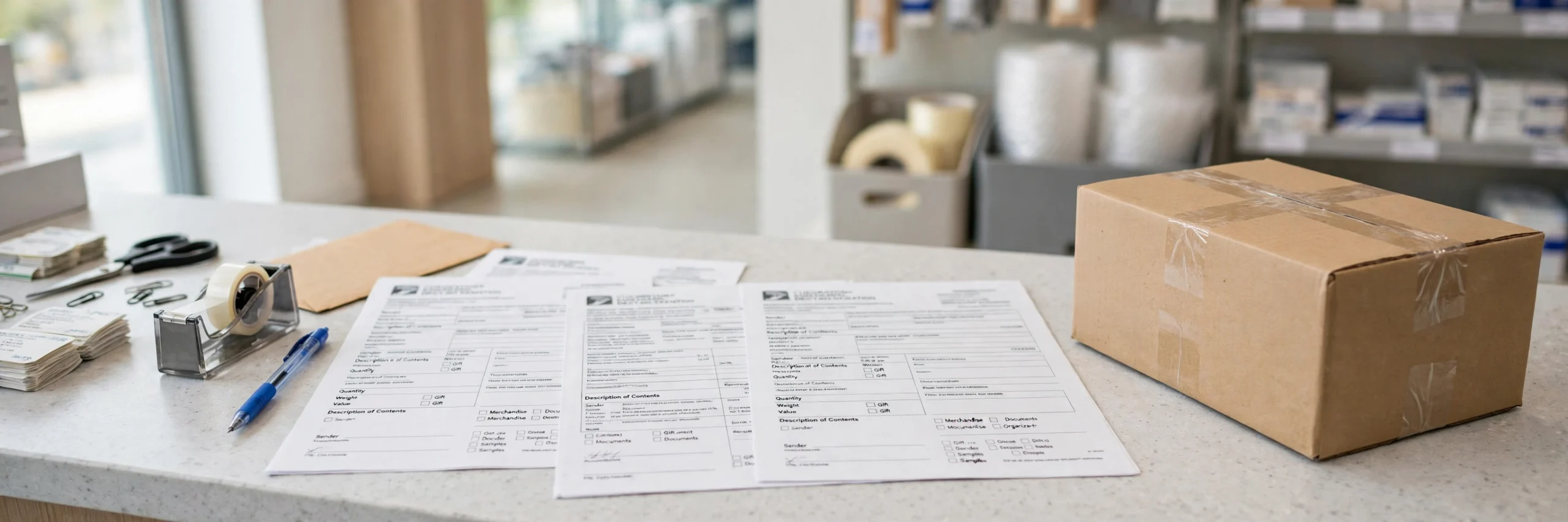
A customs declaration is a short form attached to the outside of an international parcel. It is a legal declaration: you are telling the destination country’s customs authority, in writing, what you are sending and what it is worth. Customs officers use it to decide whether the item is allowed in, whether any duty is due, and whether the parcel needs inspection. The declared value is also the basis for any compensation claim if the parcel is lost.
Which Parcels Need One?
In general, every parcel sent internationally needs a customs form, including gifts. The only common exception is a letter or documents in a plain envelope with no goods inside — but even then, some countries ask for a declaration. It does not matter which carrier you use: parcels sent by USPS, Royal Mail, Canada Post, Australia Post, India Post, Pakistan Post, China Post, Japan Post, La Poste, or a courier such as DHL all need a customs declaration. Couriers usually handle the form electronically, but you still have to provide the same information.
CN22 vs CN23
The CN22 is a small green sticker-style form, stuck directly on the parcel. Use it when the parcel is worth less than 300 SDR (Special Drawing Rights — roughly $400) and weighs less than 2 kilograms. It is the form most people use for gifts and small personal parcels.
The CN23 is a larger form, used when the parcel is worth 300 SDR or more, weighs 2 kilograms or more, or the destination country requires it whatever the value. It asks for more detail, including the weight of each item and its country of origin, and it is usually placed in a clear plastic wallet on the outside of the parcel.
Many postal services now use electronic customs forms. USPS, Royal Mail, Canada Post, and Australia Post all let you complete the declaration online when you buy postage on their website. The information reaches the destination country’s customs system before the parcel arrives, which can speed up clearance.
How to Fill In the Form
Write your full name and address as the sender — this is the return address if the parcel cannot be delivered — and the receiver’s full name and address, matching the address on the parcel itself.
The description of contents is the most important box. Describe each item clearly: “cotton T-shirt, blue, size M” or “wooden toy car, handmade” are good; “gift”, “clothes”, or “stuff” are bad. Customs officers cannot clear a parcel they cannot identify, and vague descriptions are a common cause of delays. Write how many of each item are in the parcel, the value of each item in your own currency, and the total value. Use the real value — what the item cost, or what it would cost to replace. Do not write zero, and do not under-declare the value to avoid duty. On the CN23, you also need the weight of each item.
Next, tick the category: gift, for a personal parcel with no payment; documents, for papers with no commercial value; commercial sample; merchandise, for an item that has been bought; or returned goods. Choosing the wrong category can cause duty to be charged wrongly. Finally, sign and date the form — your signature confirms the declaration is true, and a false declaration can lead to fines.
What Happens at Customs?
Once your parcel arrives, it goes through customs clearance. First, the parcel is scanned and the form is read. If the form is clear and the value is below the duty-free limit, it is often cleared automatically. If duty or VAT/GST is due, the receiver is contacted and asked to pay before delivery. Customs officers can open parcels for inspection, especially if the description is vague or the value looks wrong. Once cleared, the parcel is handed to the local postal service — USPS in the USA, Royal Mail in the UK, Canada Post in Canada — for final delivery. Most parcels clear in 1–3 working days. Delays happen when the form is incomplete, the value is disputed, or the parcel arrives at a busy time such as Christmas.
Common Mistakes to Avoid
The most common mistakes are vague descriptions, under-declaring the value, forgetting the form, sending prohibited items, and using the wrong form. Declaring a $100 item as $10 is a false declaration: if customs discovers it, the parcel can be held, fined, or seized, and any compensation claim will be based on the declared value. A parcel with no customs form will be held at the border, so check that the form is attached before you leave the post office. Each country has its own prohibited list — food, plants, medicines, and batteries are restricted in many countries. Using a CN22 for a parcel worth more than 300 SDR, or over 2 kilograms, can cause it to be returned.
Frequently Asked Questions
What is a CN22 form?
The CN22 is a small customs declaration for low-value parcels — worth less than 300 SDR and weighing less than 2 kilograms. It is stuck on the outside of the parcel.
What is a CN23 form?
The CN23 is a larger customs declaration for parcels worth 300 SDR or more, or weighing 2 kilograms or more. It asks for more detail, including weight and origin.
Do I need a customs form for a gift?
Yes. Gifts sent internationally need a customs form, just like any other parcel. Mark it as a gift — this can reduce duty in many countries, but the form is still required.
Conclusion
Customs forms are not difficult once you know what each box is for. Choose the right form — CN22 for small, low-value parcels and CN23 for larger or more valuable ones — describe every item clearly, declare its honest value, and tick the right category. A few extra minutes at the counter can save days of delay at the border.