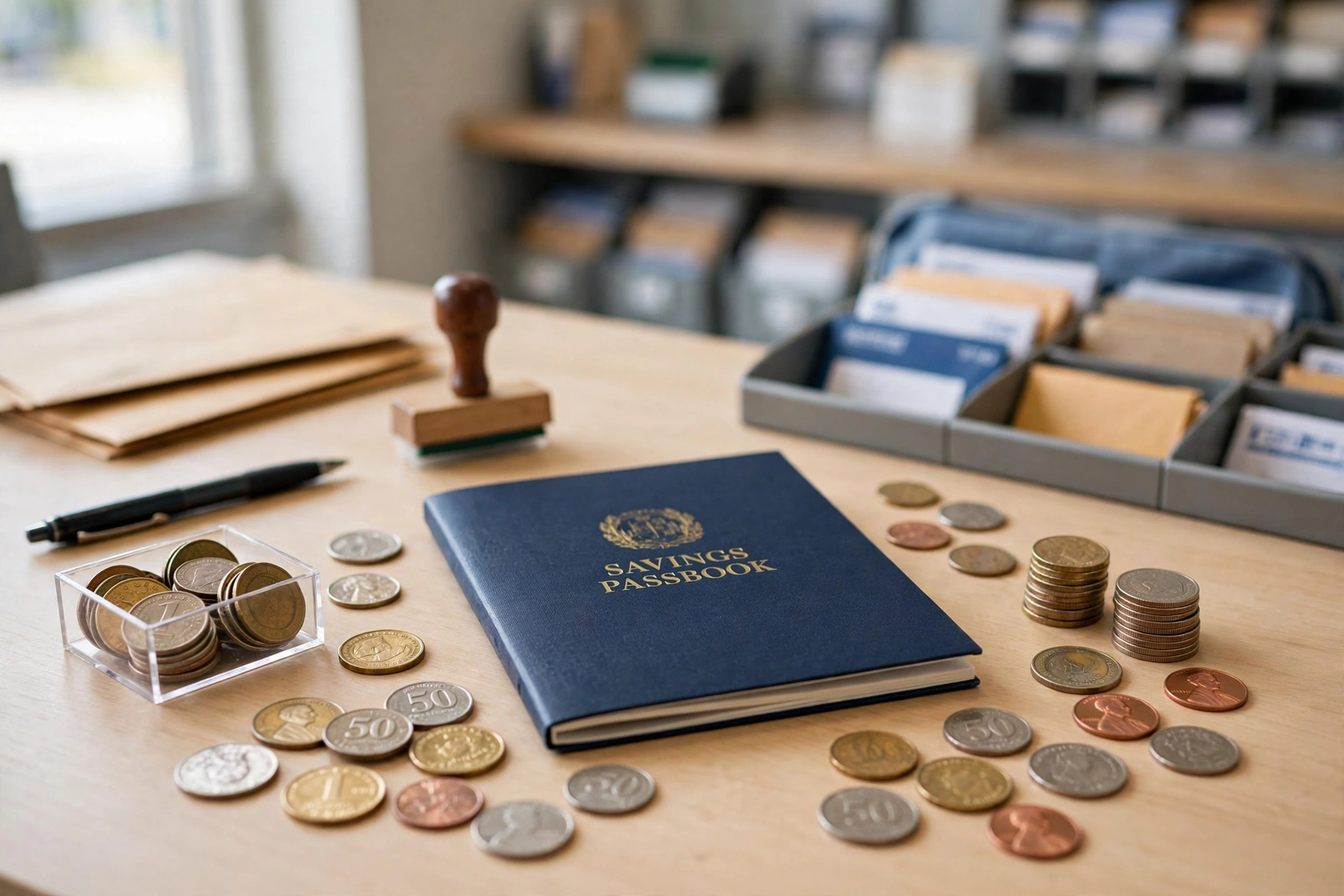
A post office savings account is one of the oldest and most trusted ways to save money. Long before online banks and mobile wallets, millions of people opened their first savings account at their local post office — and in many countries, that option is still alive, useful, and surprisingly competitive in 2026.
But what exactly is a post office savings account, how does it work, and is it worth opening one today? This guide explains it in plain language, with examples from postal services around the world.
What Is a Post Office Savings Account?
A post office savings account is a deposit account offered through a national postal service or its banking arm. You deposit money, it earns interest, and you can withdraw it when you need it — just like a bank savings account.
In some countries the post office runs the account directly. In others, it partners with a bank or operates a separate postal bank. For example, India Post runs the Post Office Savings Account through its savings schemes and India Post Payments Bank, Japan Post operates Japan Post Bank, Pakistan Post offers savings accounts and savings certificates, and La Poste in France operates La Banque Postale. Royal Mail in the UK no longer runs its own savings accounts, but Post Office counters offer banking services for many high-street banks. USPS in the United States does not currently offer a general savings account, while Canada Post and Australia Post act mainly as agents — you can deposit, withdraw, and pay bills for partner banks at the counter.
The name, interest rate, and rules differ by country, but the core idea is the same: a safe, simple place to save, backed by a government-owned postal network.
How It Works
Opening the Account
Visit your local post office with a government-issued photo ID, proof of address, and a passport-size photograph if required. You fill in a form, the clerk verifies your documents, and your account is usually opened the same day or within a few working days. Some postal banks, such as Japan Post Bank and India Post Payments Bank, also let you start the process online or through a mobile app. Joint accounts are commonly allowed, and parents can usually open an account for a minor child. The initial deposit is often very low — sometimes as little as the equivalent of $1–$10.
Depositing Money
You can deposit money at any post office branch that offers savings services, and often at ATMs or through a mobile app where a postal bank exists. Some accounts also accept bank transfers, cheques, or direct salary credit. There is usually no upper limit, though very large deposits may need extra identification. Minimum balance requirements are typically low — a deliberate feature, since postal savings were designed for ordinary savers, small traders, and rural households.
Earning Interest
Your balance earns interest, usually calculated on the daily or monthly balance and credited quarterly, half-yearly, or annually. Rates vary widely by country, so always check the current rate before opening an account. In countries with higher inflation, postal savings rates can be noticeably higher than commercial bank rates; in low-rate economies such as Japan, France, or the UK, they are modest but stable. Some postal schemes pay more than a plain savings account — for example, fixed-term deposits, recurring deposits, and national savings certificates. Interest may be taxable in your country, and in some places a small amount of postal savings interest is tax-exempt.
Withdrawing Money
Withdrawals are made at the counter with your passbook, card, or ID, and at ATMs where the postal bank issues a debit card. Many postal banks now support online transfers, bill payments, and mobile banking. Some accounts allow unlimited withdrawals; others limit free withdrawals per month. Emergency access is a strength of postal savings: with tens of thousands of branches, including in small towns and villages, a post office is often closer than the nearest bank branch.
Post Office vs. Bank Savings Account
A post office account usually wins on reach and cost: a very wide branch network including rural areas, a very low minimum deposit, and low fees. A commercial bank usually wins on digital features, instant international transfers, and credit products. On safety, both are strong — postal savings are typically government-backed, while bank deposits are protected by deposit insurance. Interest rates vary, and postal schemes are sometimes higher. Many people hold both: a bank account for everyday spending and a post office account for safe, separate saving.
Benefits and Drawbacks
The main benefits are safety, accessibility, low cost, and simplicity. Postal savings are government-backed in most countries, post offices reach villages where banks do not operate, fees are low, and passbook saving is easy to understand even without a smartphone. Many post offices also sell savings certificates, fixed deposits, and life insurance.
How to Open One in 6 Steps
- Choose your account type — a plain savings account for everyday saving, or a fixed deposit for money you will not need for months.
- Check the current interest rate and fees on the postal service website or at the counter.
- Gather your ID, proof of address, and a photo if required.
- Visit your nearest post office and ask for the savings account form.
- Make your first deposit and collect your passbook or account card.
- Set up a PIN and mobile access if offered, and keep your passbook safe.
Frequently Asked Questions
Is a post office savings account safe?
Yes. In most countries postal savings are government-backed or held by a state-owned bank, making them among the safest savings options available.
What is the interest rate in 2026?
Rates change by country and over time. Check your national postal service or postal bank website — for example, India Post, Japan Post Bank, La Banque Postale, or Pakistan Post — for the current rate.
Can I open one online?
In some countries, yes — India Post Payments Bank, Japan Post Bank, and La Banque Postale all offer online or app-based opening. In others, you still need to visit a branch in person.
The Bottom Line
A post office savings account is simple, safe, and still relevant in 2026 — especially if you value a low minimum deposit, a branch nearby, and government backing. Rates and features differ between India Post, Japan Post Bank, La Banque Postale, Pakistan Post, and other postal operators, so compare the current terms in your country before you open one.