
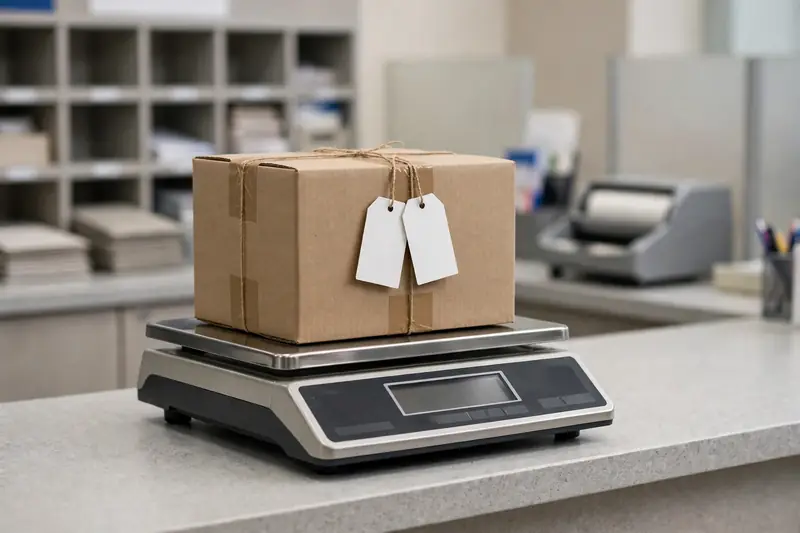
If you have ever taken a parcel to the post office and been surprised by the price, you are not alone. The same parcel can cost a different amount depending on its weight, size, destination, and the speed of delivery you choose. A small change, such as a heavier box or a faster service, can make a big difference.
This guide explains how post office parcel charges work in simple terms. You will learn what affects the price, how to read a price list, how to check the exact cost before you post, and how to save money. It covers USPS, Royal Mail, Canada Post, Australia Post, India Post, Pakistan Post, La Poste, Japan Post, China Post and DHL.
Why There Is No Single Fixed Price
Unlike a standard letter, a parcel price is worked out from several factors. The post office pays for transport, sorting, handling and delivery, and a large, heavy or urgent parcel costs more to move than a small, light, standard one.
Weight: The Biggest Factor
Weight is usually the most important factor. Postal services divide parcels into weight bands, such as up to 1 kg, up to 2 kg, and up to 5 kg. Each band has its own price, and the price rises as the weight increases. Even a small amount over a limit can push your parcel into the next band.
Weigh your parcel at home after it is packed, because the box, tape and padding all add weight. If you are close to a limit, try a lighter box, but do not remove padding that protects the item. Staff will weigh it again at the counter, and their scales are the ones that count, so leave a small margin below the limit.
Size and Shape: Why Dimensions Matter
Size matters almost as much as weight. A very long, wide or oddly shaped parcel takes up more space in a van, plane or sorting machine, and may need special handling. Some services charge by size as well as weight, and some use volumetric weight, a price based on the size of the parcel rather than its actual weight.
Volumetric weight is common for large but light parcels, such as a big box of clothes. If the volumetric weight is higher than the actual weight, you pay for the volumetric weight. Use a box that fits the item closely, with just enough padding, and no empty space. Use a normal rectangular box when you can, and remove old labels from a reused box.
Distance, Destination and Service Level
A parcel sent within the same town is usually cheapest. A parcel sent to another part of the same country costs more, and an international parcel costs the most, because it travels further and may pass through customs. Countries are grouped into zones by distance, so a parcel to a neighbouring country is usually cheaper than one to the other side of the world.
How to Read a Price List and Check the Price
A price list is usually a table. The rows show weight bands, and the columns show destinations or service levels. Find the weight of your parcel, then the destination zone, then the service you want. The price where that row and column meet is the price you will pay.
How to Save Money on Parcel Postage
Use the smallest box that fits the item safely. A smaller box weighs less and has a lower volumetric weight. Use light packaging, such as a padded envelope for small soft items, instead of a heavy box when it is safe to do so.
Parcel Charges by Country
- USPS (USA): Prices depend on weight, size, zone and service, such as Ground Advantage or Priority Mail. Use the postage calculator on the official website.
- Royal Mail (UK): Prices depend on weight, size and service, such as Tracked 24 or Special Delivery. Use the online price finder on the official website.
- Canada Post: Prices depend on weight, size, destination and service, such as Regular Parcel or Xpresspost. Use the online rate tool on the official website.
- Australia Post: Prices depend on weight, size, destination and service, such as Parcel Post or Express Post. Use the postage calculator on the official website.
- India Post: Prices depend on weight, destination and service, such as Registered Parcel or Speed Post. Check the official website or ask at your local post office.
- Pakistan Post: Prices depend on weight, destination and service. Check at your local post office for the current price list.
- La Poste (France): Prices depend on weight, size, destination and service, such as Colissimo. Use the online tariff on the official website.
- Japan Post: Prices depend on weight, size, destination and service, such as Yu-Pack or EMS. Check the official Japan Post website.
- China Post: Prices depend on weight, destination and service. Check at your local post office for the current price list.
- DHL: Prices depend on weight, size, destination and speed. Use the online quote tool on the official website.
Frequently Asked Questions
How much does it cost to send a parcel?
It depends on the weight, size, destination and service. A small light parcel sent locally with a standard service costs much less than a heavy international express parcel. Use the postage calculator on the official website, or ask at your local post office.
Why did my parcel cost more than I expected?
The parcel may have been heavier than you thought, fallen into a higher weight band, been charged by volumetric weight, or sent by a tracked or express service. Check the weight and size at home first.
Can I check parcel prices online?
Yes, most postal services have an online postage calculator on their official website. Enter the weight, size, destination and service, and it will show the current price.
How can I send a parcel more cheaply?
Use the smallest safe box, choose the slowest service that meets your deadline, weigh the parcel at home, and compare post office and courier prices. Paying online can also be cheaper than paying at the counter.